
The X-Tiles Video Series: Clear and Nickel-Plated 3D Prints, Pt. 3

Greg Paulsen
Written byGreg Paulsen
1 min read
Published October 9, 2020Updated October 8, 2024
Watch our video series, the X-Tiles, to help you distinguish between our 3D printing processes. In this release we're comparing nickel-plated prints and "clear" 3D printed parts to help you choose the best process for your project.

In Part 1 of our series, we explore differences between 3D printed parts made using various additive manufacturing processes. This continues in Part 2, where we compare more processes head-to-head to highlight their strengths and trade-offs. Now in Part 3 of our series, we'll highlight two common custom finishes for 3D prints: nickel plating and clear finishing.

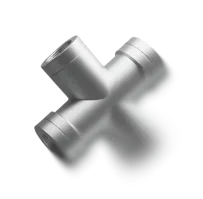
What is an X-Tile? We took the ‘X’ from our Xometry logo and designed a custom part that is about 1.5 inches square. It has flats as well as angled surfaces. The tile is producible in multiple manufacturing processes and acts as a good comparison part for material finishes and cosmetic features like layers.

Video Comparison of Nickel-Plated 3D Prints

Nickel plating is a common finish for CNC machined components, especially on metals like aluminum and steels, to prevent corrosion and add high wear resistance. Unbeknownst to many, nickel plating is also available for SLS nylon parts. Since nylon is plastic and the plating process needs a conductive surface, the first step is to cover a plastic printed part with a very fine coating of copper, then finish it with nickel. The material builds up to between +0.004”-0.006” on outer surfaces. It is important to note that nickel plating 3D prints is not a cosmetic application or solution. Instead, the outer metal shell acts as an exoskeleton which provides EMI shielding and up to 5x increased strength on features. Because the nickel coat is a build-up on the material surface, it will show the inherent surface properties of SLS parts and will display an overall matte and grainy finish. Learn more by watching the video below.

Video Comparison of “Clear” 3D Printed Parts

By far the most common request Xometry receives for 3D printed surface finishes is to transform a translucent part into a clear part. In the video below, you can see different custom finish options for translucent materials. Stereolithography (SLA) is a go-to 3D printing process for creating transparent or translucent parts. Clear SLA options include using materials like Accura 60, Accura ClearVue, Somos WaterClear Ultra 10122, and Somos Watershed XC 11122. As-printed parts are translucent, reflecting the printed surface finish (which may show minor imperfections and sanding marks from support removal). Enhanced clear finishes are typically produced through manual post-processes like hand sanding, surface treatment, and clear coats. Check out the below video to learn more.

Disclaimer

The content appearing on this webpage is for informational purposes only. Xometry makes no representation or warranty of any kind, be it expressed or implied, as to the accuracy, completeness, or validity of the information. Any performance parameters, geometric tolerances, specific design features, quality and types of materials, or processes should not be inferred to represent what will be delivered by third-party suppliers or manufacturers through Xometry’s network. Buyers seeking quotes for parts are responsible for defining the specific requirements for those parts. Please refer to our terms and conditions for more information.

Start Your Instant QuoteSTEP · STP · SLDPRT · STL · DXF · IPT · X_T · X_B · 3DXML · CATPART · PRT · SAT · 3MF · JTUpload Your Design
All uploads are secure and confidential
picture of Greg Paulsen
Greg PaulsenAs a former Sr. Solutions Engineer and Business Development leader at Xometry, Greg Paulsen worked at the intersection of engineering and growth. He developed design-for-manufacturing resources, consulted on complex custom manufacturing projects, and helped organizations transition seamlessly from prototype to production. Greg worked closely with customers to identify optimal manufacturing solutions across CNC machining, additive manufacturing, sheet metal, urethane casting, and injection molding.Read more articles by Greg Paulsen

Get in Touch

Ready to start your next manufacturing project? Our team is here to help with quotes, technical questions, and custom solutions.

By entering your contact information, you are agreeing to receive email communications about Xometry products and services. You may update your subscriptions or unsubscribe from these communications at any time using the link at the bottom of every marketing email or by contacting support. For more information, review our Privacy Policy.