
6 Properties of Metalloids


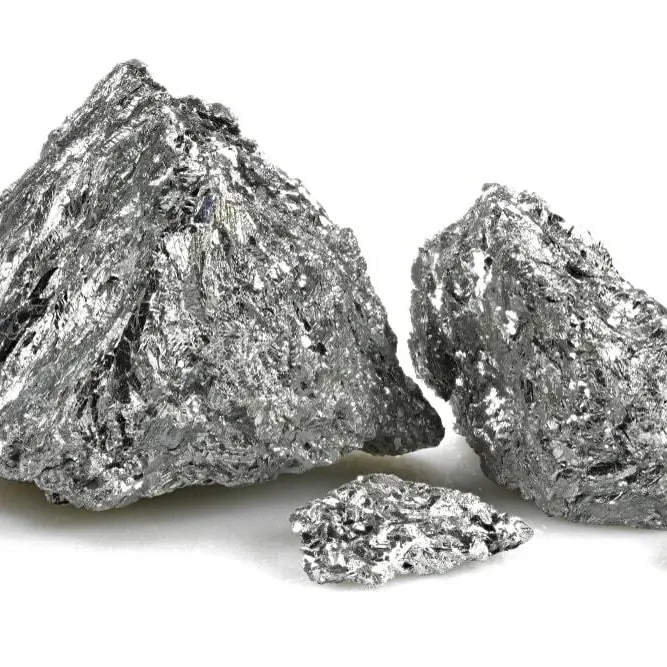
Metalloids are a class of elements that have properties of both metals and nonmetals. They fall between metals and nonmetals on the periodic table. The definition of metalloids, as well as the number of elements that fall into this group, is often debated by scientists. Boron, silicon, germanium, arsenic, tellurium, and antimony are all generally accepted as being metalloid elements, and as such, will be the focus of this article. However, while polonium, astatine, and bismuth are also sometimes classified as metalloids, they will not be discussed.
This article will describe the six most essential properties of metalloids and list some key metalloid characteristics.
1. Metalloids Are Solids
All metalloids are solid at room temperature and have relatively high melting points. The melting points of the metalloids are listed in Table 1 below:
Table 1. Melting Temperatures of Metalloids
2. Metalloids Have a Metallic Luster and Appear to be Metals
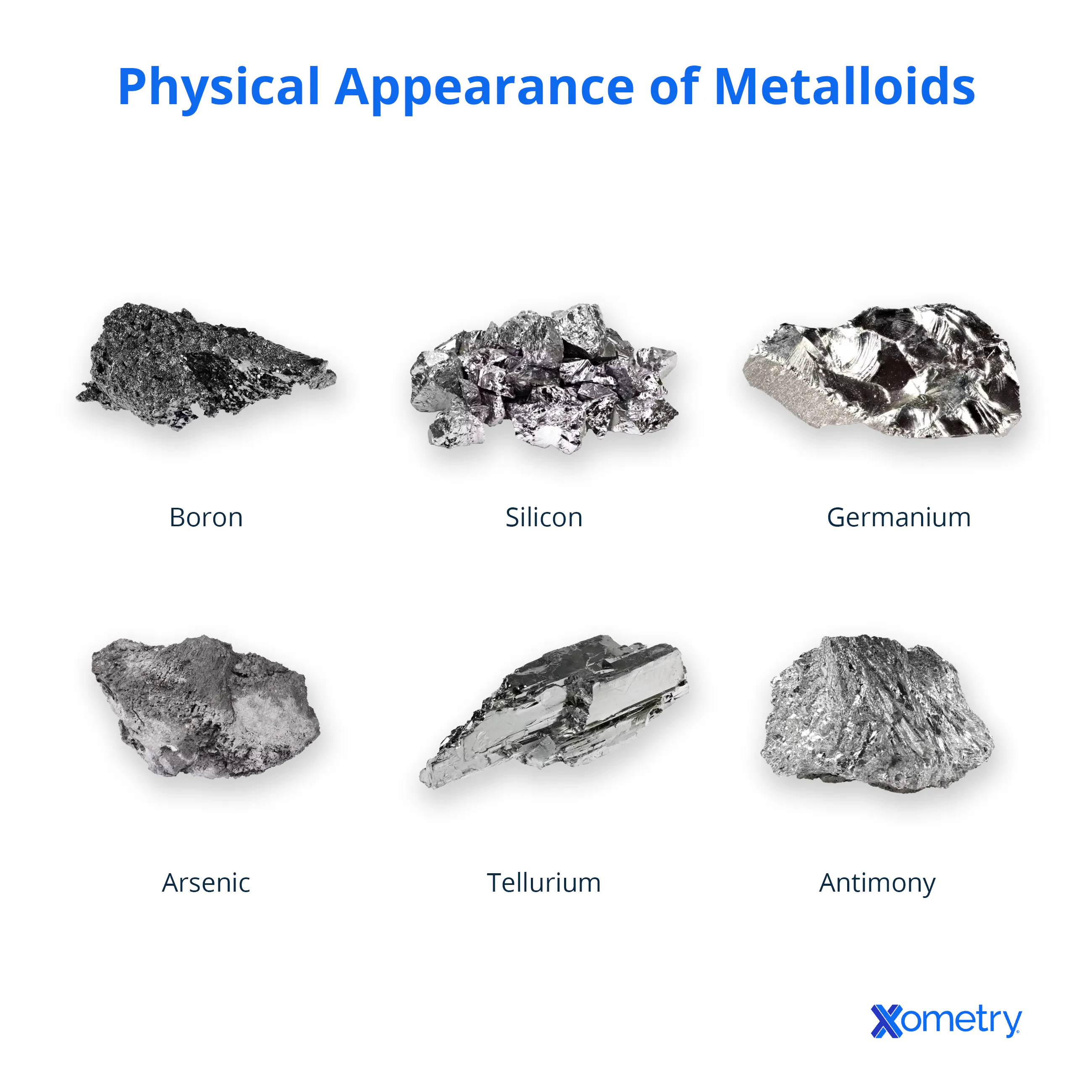
Metalloids have the physical appearance of metals. Their metallic/reflective surface makes it immediately obvious why the name "metalloid" fits these elements. The image below illustrates the visible surface characteristics of metalloids:
3. Metalloids Are Brittle and Easily Broken
Metalloids cannot be formed using the cold-forming techniques generally used for metals because they are very brittle. Metalloids will tend to fail due to brittle fracture or crumbling.
4. Metalloids Have the Ability To Conduct Electricity, but Not As Well as Metals
Metalloids can be manipulated to behave as either conductors or insulators. This semiconducting behavior is what makes some, if not all, metalloids so useful in controlling complex electronic circuits. Metalloids are modified into semiconductors useful for a wide range of circumstances by a process called "doping." Doping is the process of adding impurities to alter the properties of intrinsic semiconductors, like metalloids. Despite their valuable semiconducting capabilities, metalloids are still poor conductors of electricity compared to metals.
5. Metalloids Behave More Like Nonmetals in That They Easily Form Anions, Have Multiple Oxidation States, and Form Covalent Bonds
The oxidation state of an element refers to the number of electrons an atom either gains or loses to bond chemically with another atom. In the case of metalloids, single covalent bonds are more common. A covalent bond refers to the situation where a pair of atoms shares one electron. The oxidation states of the metalloid elements are listed in Table 2 below:
Table 2. Metalloids’ Oxidation States
6. Metalloids' Ionization Energies and Electronegativities Are Between the Values of Metals and Nonmetals
Ionization energy refers to the amount of energy that is required to strip an electron from a neutral atom to form an ion. The first ionization energy is the energy required to remove the first electron, which is the easiest to remove. Electronegativity refers to how easily an atom will attract electrons when forming a chemical bond. The higher the number, the stronger the attraction. Therefore, the higher the electronegativity value, the more likely it is that the element will attract electrons. If two elements with similar electronegativities bond, they form a pure covalent bond that shares electrons equally. However, if elements have different electronegativities, the resulting molecule will be polarized. This is because the electrons in the bond will be attracted more strongly to the element with stronger electronegativity.
The metalloids listed in Table 3 below have ionization energies and electronegativities as shown:
Table 3. Metalloids’ 1st Ionization Energies and Electronegativities
"Metalloids are elements that exhibit characteristics of both metals and nonmetals, bridging the gap between the two on the periodic table. The article highlights six key properties: they are solid at room temperature, have a metallic sheen, are brittle, conduct electricity moderately, form covalent bonds, and possess intermediate ionization energies and electronegativities. Their semiconducting behavior, particularly in elements like silicon and boron, makes them vital for electronic and industrial applications."
What Distinguishes Metalloids?
The key distinguishing properties of metalloids are that they have characteristics of both metals and nonmetals. Their ability to act as semiconductors is a unique and essential feature of some metalloids. This makes metalloids indispensable in an era when electronic circuits are everywhere.
For more information, see our guide on the Elements of Metalloids.
Which Property is the Most Useful for Identifying a Metalloid?
Most metalloids can be visually identified by their metallic appearance. Identifying metalloids by their chemical attributes is generally more difficult, as there are no properties of metalloids that make them stand out distinctly enough from other elements.
What Elements are Commonly Referred to as Metalloids?
The elements that are commonly referred to as metalloids are listed in Table 4, along with brief descriptions and a few typical applications:
Table 4. Metalloids: Descriptions and Typical Applications
Differences Between Metals and Nonmetals
Some differences between metals and nonmetals are shown in Table 5 below:
Table 5. Comparison of Metals and Nonmetals
Common FAQs About Metalloid Properties
Summary
Xometry provides a wide range of manufacturing capabilities including 3D printing, CNC machining, laser cutting, and injection molding. Get your instant quote today.
Disclaimer
The content appearing on this webpage is for informational purposes only. Xometry makes no representation or warranty of any kind, be it expressed or implied, as to the accuracy, completeness, or validity of the information. Any performance parameters, geometric tolerances, specific design features, quality and types of materials, or processes should not be inferred to represent what will be delivered by third-party suppliers or manufacturers through Xometry’s network. Buyers seeking quotes for parts are responsible for defining the specific requirements for those parts. Please refer to our terms and conditions for more information.