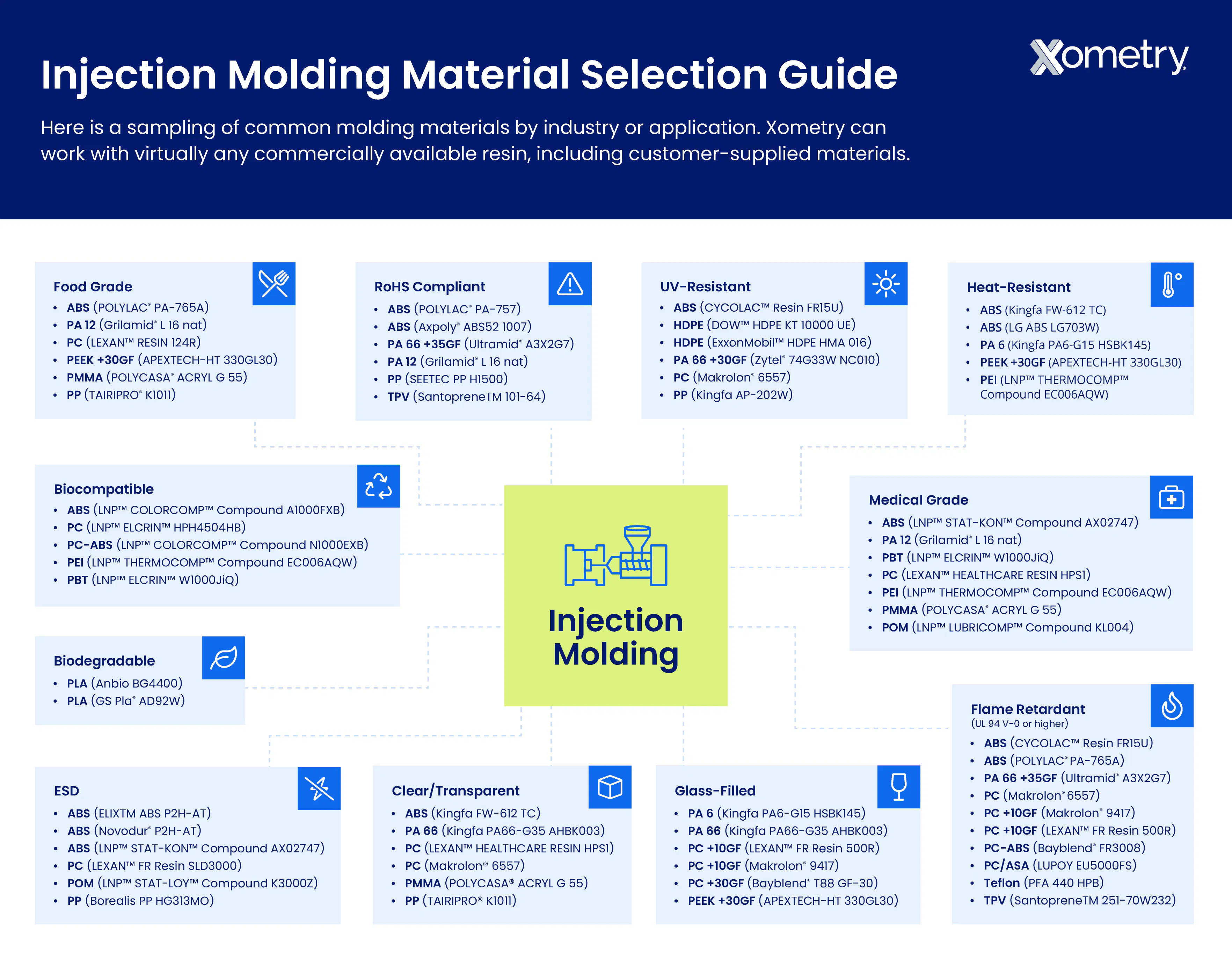
Injection Molding Material Selection Guide


The injection molding material selection guide involves choosing the appropriate thermoplastic or thermoset polymer based on the requirements of the molded part. The selection is influenced by the material's properties (mechanical strength, surface finish, temperature resistance, and chemical stability), which must align with the part's intended use. Each material type directly impacts mechanical strength, surface finish, temperature resistance, chemical stability, and wear resistance. The specific application of the part determines the importance of each of the attributes. Selecting the right material depends on part function, environmental conditions (such as exposure to chemicals, moisture, and temperature extremes), and cost constraints. Material choice must consider mechanical properties (strength, durability, and wear resistance).
Material selection is necessary for optimal product performance. Incorrect material choices lead to warping, brittleness, poor impact resistance, or failure under mechanical load issues. Material properties must be aligned with the part's function and operational conditions to avoid these problems. For example, nylon works well for gears because of its high fatigue strength and lubricity. Acrylonitrile Butadiene Styrene (ABS) suits housings where impact strength and surface aesthetics matter. Polycarbonate offers clarity and toughness for protective covers.
Material choice determines cycle time, ease of molding, and tooling requirements. High-temperature materials (Polyether Ether Ketone) demand specialized equipment, while commodity resins (polypropylene) offer shorter cycles and lower mold wear. Cost trade-offs must balance part quantity, durability needs, and processing demands.
Xometry emphasizes that material selection is a design consideration and a production constraint. Successful designs integrate mechanical needs with processing feasibility. Engineers must evaluate shrinkage, fill behavior, and melt flow to avoid defects. Best practices include testing with sample runs and consulting with material data sheets.
Users of injection molding services benefit most when material selection aligns with end-use requirements, tool design, and economic factors. Each decision affects quality, efficiency, and production scalability.
Why Does Material Selection Matter in Injection Molding?
Material selection matters in injection molding because it determines the balance between part strength, flexibility, appearance, cost, and production efficiency. The mechanical and thermal properties of a chosen material influence how a part performs under stress or heat. For example, polycarbonate offers high impact resistance for protective housings, while polypropylene delivers flexibility for living hinges and consumer containers.
The selected resin directly affects production speed and tool wear. Materials that require lower mold temperatures generally allow shorter cycle times, while high-performance polymers require higher mold temperatures and longer cooling phases. Material characteristics influence surface finish, color consistency, and dimensional accuracy, shaping functionality, and aesthetics.
Proper material selection extends the product’s lifecycle by preventing cracking, deformation, and premature failure. Matching material behavior with end-use conditions (UV exposure, load-bearing needs, or chemical contact) ensures reliability over time. Every decision impacts long-term performance and the cost-effectiveness of injection molding services.
What Are the Key Factors to Consider When Choosing Injection Molding Materials?
The key Factors to consider when Choosing Injection Molding Materials are listed below.
- Mechanical Properties: Select materials based on strength, stiffness, toughness, and impact resistance. For example, ABS offers balanced strength and toughness for enclosures, while nylon supports high-load applications (gears).
- Chemical Resistance: Choose materials that resist solvents, oils, acids, or other chemicals the product encounters. Polyethylene resists moisture and chemicals, making it ideal for containers and medical parts.
- Temperature Tolerance: Evaluate heat resistance for parts exposed to elevated temperatures. Polyether Ether Ketone (PEEK) and Polyphenylene Sulfide (PPS) handle high thermal loads in aerospace and automotive uses, while low-melting plastics (High-Density Polyethylene) suit cooler environments.
- Aesthetics: Consider surface finish, colorability, and gloss. Polystyrene enables high-gloss finishes, while polypropylene supports translucent effects. Surface appearance impacts consumer acceptance and branding.
- Regulatory Compliance: Verify if materials meet Food and Drug Administration (FDA), Restriction of Hazardous Substances (RoHS), or Underwriters Laboratories (UL) requirements for safety, medical, or electronic applications. Medical devices require biocompatible plastics, while electronics need flame-retardant grades.
- Cost Efficiency: Balance raw material prices with production efficiency and part longevity. Commodity resins lower costs for high-volume runs, while engineering plastics raise upfront costs but increase durability.
"Choosing the right polymer is not about picking a familiar material. It is about matching strength, durability, processing behavior, and cost to the real demands of the part. Good engineering starts with understanding how materials behave long before the mold is built."
How Do Mechanical Properties Influence Injection Molding Material Selection?
Mechanical properties influence the selection of materials for injection molding, as they determine how a finished part performs under mechanical stress and physical use. Tensile strength is a key property that defines how much force a material withstands before breaking. Materials (nylon and polycarbonate) are known for their high tensile strength, making them ideal for applications (automotive gears, safety helmets, and mechanical components) that are exposed to continuous loads.
Impact resistance measures a material's ability to absorb sudden shocks without fracturing. ABS and polypropylene are commonly used in applications (housings, bumpers, and tool handles) because of their ability to maintain structural integrity under impact forces. Hardness is critical for assessing a material's resistance to scratches and wear over time. Acetal (POM) is an ideal material due to its exceptional durability and low wear characteristics for moving parts and precision fittings.
Flexibility is essential for parts that need to bend or move without breaking. Thermoplastic elastomers (TPE) and medical-grade silicones are preferred in applications (medical devices and consumer goods) as they offer a combination of elasticity, biocompatibility, and long-term performance. Achieving the right balance of mechanical properties ensures consistent part performance, safety, and manufacturability across various injection molding applications.
What Role Does Chemical and Environmental Resistance Play in Material Choice?
The role of chemical and environmental resistance in material selection is essential for protecting molded parts from degradation, structural failure, or discoloration when exposed to harsh conditions. Chemical resistance prevents damage from solvents, oils, fuels, and cleaning agents. For example, acetal and polyethylene are resistant to repeated contact with automotive fluids and industrial chemicals, maintaining their structural integrity without swelling or cracking.
Moisture resistance is essential for parts used in damp or submerged conditions. Polypropylene resists moisture absorption and retains its stability even in wet environments, while nylon absorbs moisture and expands, which leads to dimensional instability. UV resistance is critical for outdoor applications, as prolonged exposure to sunlight causes materials to yellow, become brittle, or degrade. Acrylonitrile Styrene Acrylate (ASA) and UV-stabilized polyethylene maintain their color and mechanical properties when exposed to extended sunlight.
Products used in outdoor, medical, or automotive applications require careful material selection to ensure long-term durability. For instance, outdoor furniture, cable housings, and dashboard components rely on resins that withstand heat, sunlight, and chemical contact without losing structural integrity. Parts exposed to sterilization processes must be made from plastics that endure high-temperature cycles without warping or degrading in medical applications. Choosing materials with the appropriate chemical and environmental resistance properties ensures product reliability and longevity in injection molding.
How Does Temperature Tolerance Affect Injection Molded Parts?
Temperature tolerance affects injection-molded parts by determining how materials behave under heat or cold during use and processing. Materials exposed to high operating temperatures must retain strength, shape, and stability. PEEK performs under continuous temperatures above 250°C, making it suitable for aerospace brackets, electrical insulators, and engine components. Nylon endures elevated conditions in automotive environments (intake manifolds and under-the-hood clips).
Cold temperatures impact flexibility and brittleness. Polypropylene retains its form in cold storage, while polystyrene becomes brittle and prone to cracking. Molding temperature tolerance affects cycle time and tooling demands. Materials with high melting points need longer cooling, increasing production time and mold wear.
Mismatch between temperature performance and end-use environment shortens product life and causes structural failures. Correct material selection supports dimensional stability, product safety, and long-term function in injection molding services.
What Are the Most Common Injection Molding Materials?
The most common injection molding materials are ABS, polypropylene, polycarbonate, polyethylene, nylon, and PEEK. Each material offers a unique balance of strength, flexibility, cost, and durability that suits specific applications across industries.
ABS provides toughness, good surface finish, and impact resistance. It suits consumer electronics and automotive interiors but lacks strong chemical and UV resistance. Polypropylene offers chemical resistance, flexibility, and low cost, making it ideal for packaging, medical devices, and living hinges. Its downside lies in lower temperature tolerance.
Polycarbonate delivers high clarity, strength, and heat resistance. It works well for protective covers and optical components, but tends to scratch and has limited chemical resistance. Polyethylene is lightweight and moisture-resistant, used for containers and tubing, though it offers less stiffness.
Nylon combines strength, wear resistance, and thermal stability for gears and mechanical parts, but absorbs moisture. PEEK supports high-performance needs with exceptional heat, chemical, and wear resistance, though its cost is higher, and molding requires precision control.
Xometry offers the capability to source and process each of these materials to match the design, function, and material selection needs in injection molding services.
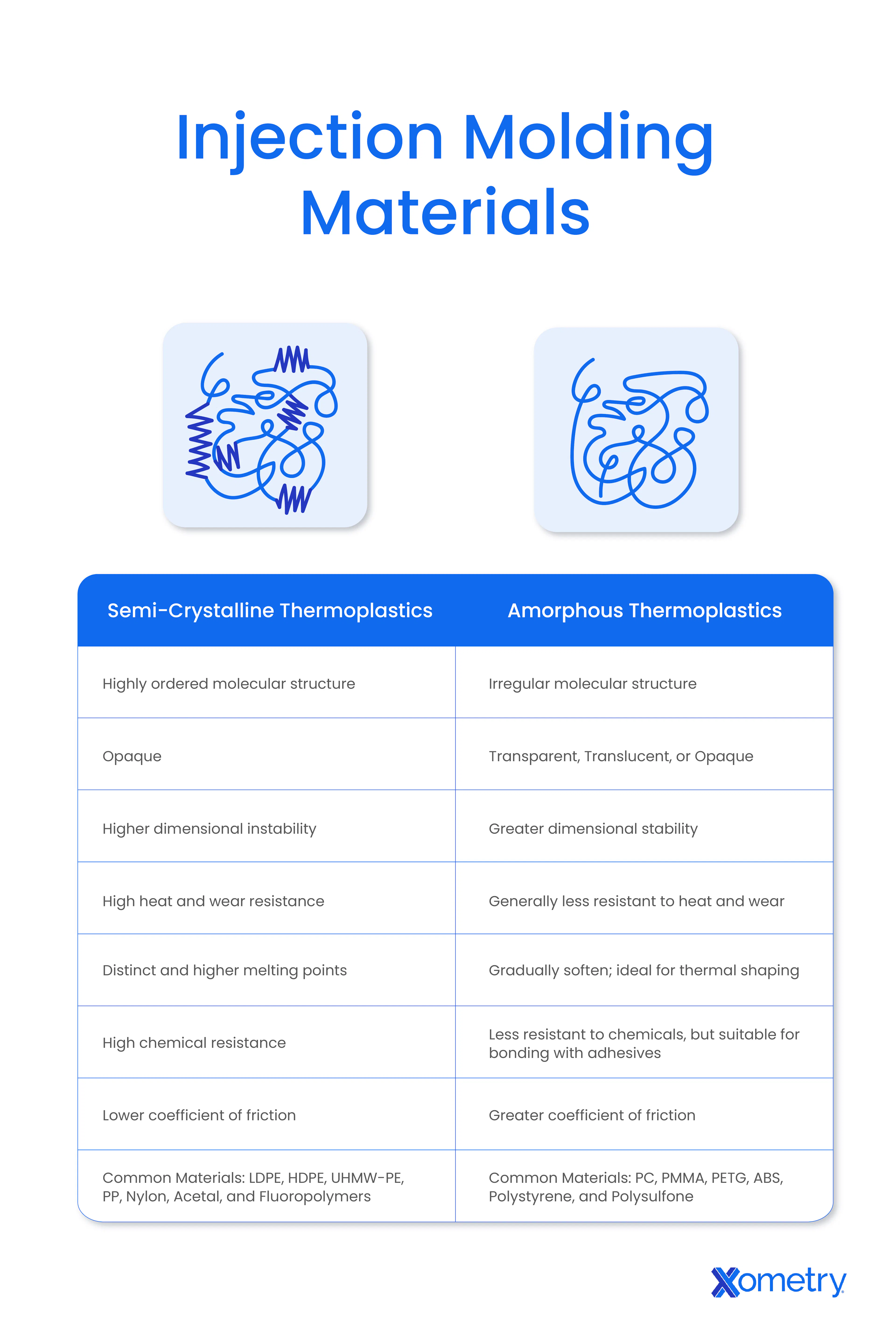
Why is ABS a Popular Choice for Injection Molding?
ABS is a popular choice for injection molding because it provides a reliable balance of strength, impact resistance, and affordability. The material resists physical shock without cracking and holds its shape well under daily use. It supports tight tolerances and smooth surface finishes, which makes it ideal for parts requiring aesthetic appeal and structural stability.
ABS is used extensively in consumer products (remote controls, computer keyboards, and appliance housings). It is common in automotive dashboards and trim components where appearance and performance matter equally. The cost-effectiveness of ABS makes it suitable for high-volume production without compromising part quality.
Xometry supports ABS across various applications through its injection molding services, helping manufacturers optimize performance through accurate material selection.
What Makes Polypropylene a Versatile Injection Molding Material?
Lightweight structure, strong chemical resistance, and natural flexibility make Polypropylene a versatile injection molding material. The material weighs less than many engineering plastics, allowing for reduced shipping costs and easier handling. Its resistance to acids, bases, and organic solvents supports safe use in environments where chemical exposure is common.
Polypropylene bends without breaking, which makes it ideal for living hinges, snap-fit components, and soft-touch parts. It maintains structural integrity under repeated stress, making it suitable for high-cycle parts. The low moisture absorption prevents warping and ensures dimensional stability in humid or wet conditions.
Polypropylene appears in packaging containers, bottle caps, and dispensers. It is common in automotive panels, battery cases, and interior trim. Medical-grade variants support syringes, labware, and single-use items. Consistent processing behavior and low cost contribute to its broad use across injection molding services, supporting practical and cost-effective material selection.
Is Nylon (Polyamide) Used in Engineering Applications?
Yes, Nylon (Polyamide) is used in engineering applications because of its high strength, wear resistance, and long-term durability. Nylon handles repeated mechanical stress without deformation and resists abrasion during continuous motion. The material supports precise tolerances and maintains performance under load. Common uses include gears, bushings, bearings, and structural components where consistent function and reliability are required. Nylon is processed through injection molding services, enabling precise material selection for demanding parts.
What Are the Advantages of Using Polycarbonate in Injection Molding?
The advantages of Using Polycarbonate in Injection Molding are listed below.
- Optical Clarity: Polycarbonate provides excellent light transmission, making it suitable for lenses, light covers, and transparent enclosures. It maintains transparency without yellowing over time.
- Impact Resistance: The material absorbs shock without cracking, which makes it ideal for safety glasses, protective housings, and enclosures that require durability under stress.
- Heat Resistance: Polycarbonate withstands higher temperatures than most commodity plastics, supporting applications that involve exposure to heat or sterilization processes.
- Dimensional Stability: Parts made from polycarbonate hold tight tolerances and resist warping, even when exposed to varying environmental conditions.
- Versatile Use Cases: Polycarbonate is used in medical device housings, automotive lighting components, and electronics where clarity, strength, and precision are required.
How Do Cost and Production Volume Affect Material Selection?
Cost and production volume affect material selection by influencing the balance between performance and manufacturing efficiency. Premium engineering resins (PEEK or PPS) offer high strength and durability but raise material and tooling costs. Commodity plastics (polypropylene or polystyrene) reduce expenses and speed up production but offer limited mechanical properties.
High-volume runs favor lower-cost materials with short cycle times to minimize per-unit cost. The materials suit consumer packaging, disposable medical components, and automotive interiors. Low-volume runs or specialized applications justify higher-cost resins to meet critical performance requirements (chemical resistance or thermal stability).
Xometry helps match design needs with economic constraints through expert support in injection molding services and sheet metal fabrication, ensuring smart and scalable material selection.
How Do Industry Standards Shape Injection Molding Material Selection?
Industry standards shape injection molding material selection by defining the regulatory, safety, and performance requirements each part must meet in its final application. Standards ensure that materials used in production comply with structural, chemical, and environmental benchmarks required across sectors.
Materials must meet ISO and OEM specifications for thermal stability, flame resistance, and mechanical load capacity in the automotive industry. Nylon and polypropylene are common for under-the-hood parts due to their strength and temperature tolerance. The aerospace sector requires high-performance thermoplastics (PEEK or PPS) that conform to Federal Aviation Administration (FAA) and American Society for Testing and Materials (ASTM) standards for flame, smoke, and toxicity.
Compliance with the FDA and the International Organization for Standardization (ISO) 10993 requires biocompatible plastics (medical-grade polyethylene or TPE) in medical manufacturing. Sterilization resistance and traceability are key factors in material choice. Safety standards (RoHS and UL) guide manufacturers in choosing non-toxic, durable, and flame-resistant materials for consumer goods.
Material decisions must align with specific approval criteria. Failure to meet these requirements results in product recalls, regulatory penalties, or safety failures. Xometry supports precise compliance through its injection molding services, helping manufacturers align functional needs with approved material selection.
What Are the Common Mistakes in Injection Molding Material Selection?
The Common Mistakes in Injection Molding Material Selection are listed below.
- Ignoring Environmental Exposure: Selecting materials without accounting for heat, moisture, UV, or chemical contact leads to degradation, warping, or failure. Outdoor or industrial parts require UV-stable, chemical-resistant plastics.
- Overlooking Mechanical Requirements: Using low-strength or brittle materials for load-bearing parts compromises safety and durability. Applications involving motion or impact require resins with appropriate toughness and fatigue resistance.
- Underestimating Material Costs: Choosing premium resins (PEEK) for non-critical parts increases production expenses unnecessarily. Cost must align with performance demands and production scale.
- Neglecting Production Tolerances: Failing to match material behavior with mold design results in dimensional inconsistencies or defects. Engineers must account for shrinkage, melt flow, and cooling properties.
- Skipping Compliance Checks: Using materials that do not meet FDA, UL, RoHS, or ISO standards leads to failed certifications or legal risks. Regulated industries require approved materials only.
- Assuming One Material Fits All: Relying on a familiar plastic for all applications ignores unique part requirements. Material choice must reflect each product’s function, environment, and lifespan.
How Can Engineers Optimize Material Selection with Xometry?
Engineers can optimize material selection with Xometry by leveraging its integrated tools, expert guidance, and production capabilities tailored to part performance and cost targets. Xometry serves as a solutions partner by providing access to a comprehensive material database with detailed property comparisons for thermoplastics and engineering resins. The platform delivers design-for-manufacturability (DFM) feedback, helping engineers align material behavior with mold design, tolerances, and production needs. Direct consultation with Xometry’s engineering team supports critical decisions involving chemical resistance, thermal performance, or regulatory compliance. Prototyping and low-volume runs through the on-demand manufacturing network enable real-world testing before scaling to mass production. The capabilities combine to support accurate, application-specific choices through the Xometry platform, improving outcomes across injection molding services.
What is the Best Material for Injection Molding?
The best material for injection molding is polypropylene when flexibility, chemical resistance, and low cost are priorities. No single material suits every application. The optimal choice depends on mechanical, thermal, and regulatory demands.
ABS works well for durable consumer products that need impact resistance and a clean surface finish. Nylon supports automotive components where wear resistance and strength matter. PEEK fits aerospace and medical applications requiring high heat resistance and precision. Each selection must match end-use conditions, design goals, and compliance standards.
Xometry supports accurate decisions across applications by guiding performance-based material selection through its expert-driven injection molding services.
What is the Strongest Plastic for Injection Molding?
The strongest plastic for injection molding is PEEK (Polyether Ether Ketone) due to its exceptional tensile strength, heat resistance, and chemical stability. PEEK maintains structural integrity under continuous stress and extreme temperatures, making it ideal for aerospace brackets, turbine components, and medical implants.
Polycarbonate offers high impact strength and dimensional stability, commonly used in protective gear, lighting housings, and safety enclosures. Glass-filled nylon reinforces standard nylon with glass fibers to increase stiffness, strength, and thermal resistance. The variant supports load-bearing parts in automotive, industrial, and structural assemblies.
Each of the engineering resins supports demanding mechanical roles through accurate material selection, enabling long-term durability and performance in injection molding services processed through the Xometry platform.
What is the Cheapest Plastic for Injection Molding?
The cheapest plastic for injection molding is polypropylene, followed closely by polyethylene. Polypropylene and polyethylene are classified as commodity plastics due to their low material cost, wide availability, and easy processing. Polypropylene offers good chemical resistance and flexibility, making it ideal for packaging lids, containers, and household products. Polyethylene provides moisture resistance and softness, common in squeeze bottles, tubing, and lightweight consumer parts.
The materials support high-volume production with short cycle times, reducing part cost. Their low shrinkage and consistent molding behavior allow predictable results in basic applications. The options remain practical for most non-structural parts for manufacturers focusing on budget efficiency and simplified design.
Xometry supports cost-focused production using commodity resins through its injection molding services. It has scalable access managed across the Xometry platform to match exact material selection goals.
Which Materials are FDA-Approved for Medical Injection Molding?
Materials that can be formulated to meet FDA requirements for medical injection molding are listed below.
- Polypropylene (PP): PP is biocompatible, chemically resistant, and supports steam sterilization. It is used in syringes, medical containers, and disposable devices.
- Polycarbonate (PC): PC is known for clarity, impact resistance, and heat stability. Polycarbonate is used in medical housings, diagnostic equipment, and surgical instruments. It supports gamma and Ethylene Oxide (EtO) sterilization.
- Medical-Grade ABS: The variation of ABS meets FDA requirements for contact with the human body and pharmaceuticals. It is ideal for enclosures, handles, and durable medical components.
- Polyethylene (PE): PE is used for tubing and packaging. Polyethylene is non-reactive, flexible, and supports contact with bodily fluids. It comes in high-density (HDPE) and low-density (LDPE) forms for various functions.
- Polyetheretherketone (PEEK): The high-performance resin offers biocompatibility, high heat resistance, and strength. It is suitable for implantable devices and reusable surgical tools.
Xometry supports FDA-compliant production through its injection molding services, guiding precise material selection with full traceability across the platform for medical manufacturing needs.
Disclaimer
The content appearing on this webpage is for informational purposes only. Xometry makes no representation or warranty of any kind, be it expressed or implied, as to the accuracy, completeness, or validity of the information. Any performance parameters, geometric tolerances, specific design features, quality and types of materials, or processes should not be inferred to represent what will be delivered by third-party suppliers or manufacturers through Xometry’s network. Buyers seeking quotes for parts are responsible for defining the specific requirements for those parts. Please refer to our terms and conditions for more information.