Electrical Discharge Machining: Diagram, Process, and Manufacturing


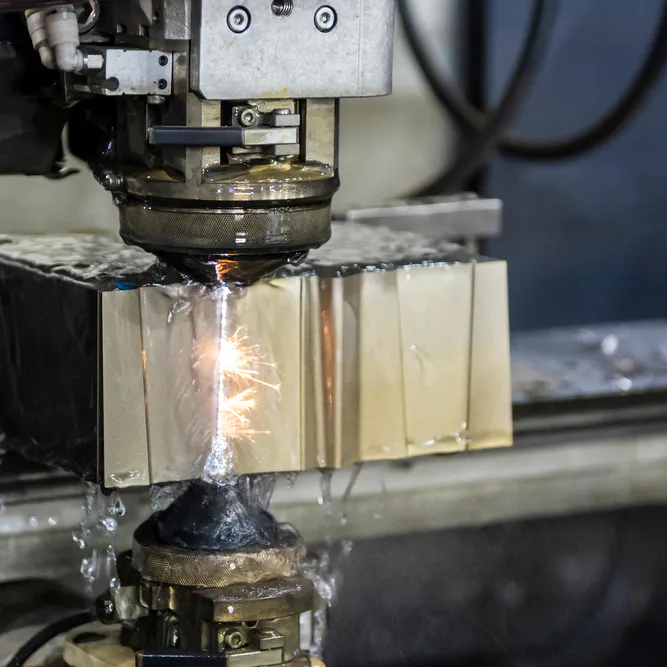
Electrical Discharge Machining (EDM) is a non-traditional manufacturing process that removes material from electrically conductive workpieces through controlled spark erosion in a dielectric fluid. The EDM process works by generating rapid electrical discharges between an electrode and the workpiece, producing localized temperatures of 8,000°C to 12,000°C that melt and vaporize microscopic material particles while the dielectric medium stabilizes the spark gap and removes debris. EDM (wire EDM, sinker EDM, and hole drilling EDM) is designed for specific geometric requirements. Advantages (machining hardened alloys without mechanical cutting forces, producing complex internal geometries, and achieving very high dimensional accuracy, around ±0.005–±0.02 mm depending on machine capability, part size, and process parameters). Limitations include slower material removal rates, the requirement for electrical conductivity, electrode wear in sinker EDM, and potential recast layer formation. Compared to CNC machining, EDM excels in hardened conductive materials and intricate cavities, while CNC machining provides faster removal rates and broader material compatibility; compared to plasma cutting, EDM delivers significantly tighter tolerances and finer surface finishes suited for precision components.
What is Electrical Discharge Machining (EDM)?
Electrical Discharge Machining (EDM) is a thermal erosion process that removes material from electrically conductive workpieces using controlled spark discharges within a dielectric fluid. A power supply generates rapid electrical pulses across a regulated spark gap between an electrode and the workpiece, producing localized plasma temperatures that melt and vaporize microscopic material volumes. Material hardness generally has little influence on EDM machinability compared to conventional machining, though electrical conductivity, melting temperature, and thermal properties influence machining efficiency. The non-contact nature of EDM eliminates mechanical cutting forces, reducing distortion in thin or delicate components.
The process produces a recast layer and heat-affected zone that finishing passes refine to achieve high precision tolerances, around ±0.005–±0.02 mm depending on machine capability, part geometry, and process conditions. Industries requiring hardened tooling, intricate internal geometries, and precision cavities rely on EDM as a controlled alternative to conventional machining processes. Wire EDM uses a continuously fed wire electrode to cut profiles and fine contours with high dimensional stability. Sinker EDM employs shaped graphite or copper electrodes to form complex cavities in molds and dies. Process parameters such as pulse duration, peak current, and dielectric flushing rate directly influence surface finish and material removal rate. Advanced CNC-controlled EDM systems maintain precise spark gaps through servo regulation to ensure repeatability and accuracy in high-tolerance manufacturing environments.
What Does EDM stand for in Engineering?
Electrical Discharge Machining (EDM) is a thermal erosion process that removes material from electrically conductive workpieces using controlled spark discharges within a dielectric fluid. A power supply generates rapid electrical pulses across a regulated spark gap between an electrode and the workpiece, producing localized plasma temperatures that melt and vaporize microscopic volumes of material. Material hardness does not significantly affect EDM performance; electrical conductivity, melting point, and thermal properties influence machining efficiency. The non-contact nature of EDM eliminates mechanical cutting forces, reducing distortion in thin or delicate components. The process produces a recast layer and a thin heat-affected zone that finishing passes reduce to improve surface integrity, with high precision tolerances around ±0.005–±0.02 mm depending on machine capability, geometry, and process parameters. Industries requiring hardened conductive tooling, intricate internal geometries, and precision cavities rely on EDM as a controlled alternative to conventional machining processes.
Is Electrical Discharge Machining EDM a Nontraditional Machining Process?
Yes, electrical discharge machining is classified as a non-traditional machining process because it removes material without mechanical contact or cutting forces. Conventional machining removes material through shear deformation using a harder cutting tool, whereas EDM removes material through localized thermal erosion generated by controlled electrical discharges. EDM belongs to non-traditional machining processes, while laser beam machining and electron beam machining are thermal energy–based machining processes within the broader non-traditional category. EDM machines use electrically conductive materials, and machining performance depends on electrical conductivity, melting temperature, thermal conductivity, and discharge parameters rather than mechanical hardness. Material removal rate is governed by electrical and thermal characteristics of the material combined with controlled spark energy and flushing efficiency.
How Does the Electrical Discharge Machining EDM Process Work?
The Electrical Discharge Machining process operates by establishing a controlled electrical circuit between an electrode and an electrically conductive workpiece submerged in a dielectric fluid. The dielectric remains non-conductive until the electric field strength exceeds the breakdown voltage of the spark gap, causing ionization and plasma channel formation. Material removal occurs through melting and vaporization followed by rapid cooling and dielectric flushing that removes debris from the spark gap. A pulsed power supply interrupts current flow after each discharge, allowing debris removal and gap stabilization before the next spark occurs. The cycle repeats thousands of times per second under CNC-controlled servo regulation that maintains a precise spark gap using voltage and current feedback. The geometry of the electrode or the programmed path of the wire defines the final component shape. Surface finish depends on discharge energy, pulse duration, peak current, and flushing efficiency, with lower energy settings producing smaller discharge craters and smoother finishes.
What Are the Steps in the Electrical Discharge Machining EDM Machining Process?
The steps in the electrical discharge machining (EDM) process are listed below.
- Setup: The operator secures the electrically conductive workpiece on the machine table and aligns the electrode or programs the wire path under CNC control to meet dimensional specifications.
- Dielectric Application: In sinker EDM, the work tank fills with dielectric fluid to submerge the electrode and part, while wire EDM uses controlled dielectric flow around the cutting zone to insulate and cool the spark gap.
- Spark Generation: The pulsed power supply delivers controlled electrical discharges across a regulated spark gap, producing localized plasma temperatures that melt and partially vaporize microscopic volumes of material.
- Flushing and Gap Control: Dielectric flushing removes debris from the spark gap and helps maintain stable discharge conditions, though flushing effectiveness depends on flow rate, electrode design, and machining parameters.
Does Electrical Discharge Machining EDM Remove Metal Without Physical Contact?
Yes, Electrical Discharge Machining removes metal without physical contact between the electrode and the workpiece. Spark erosion transfers thermal energy across a controlled microscopic gap filled with dielectric fluid. The dielectric medium maintains electrical insulation while enabling plasma channel formation during each discharge cycle. The absence of mechanical cutting forces reduces distortion in thin or delicate components. Servo-controlled gap regulation prevents unintended contact and ensures stable spark generation. Electrode wear occurs in sinker EDM due to spark erosion, while wire EDM continuously feeds wire to maintain consistent cutting conditions. Each electrical discharge produces localized plasma temperatures ranging from 8,000°C to 12,000°C that melt and partially vaporize microscopic material volumes. Material removal occurs through melting and partial vaporization, followed by rapid cooling and flushing by the dielectric fluid that removes debris from the spark gap. The process requires electrically conductive materials, and machining performance depends on electrical conductivity, melting point, and thermal conductivity rather than hardness. Controlled adjustment of pulse duration, peak current, and discharge energy allows manufacturers to balance material removal rate with surface finish and dimensional accuracy.
What Are the Different Types of EDM Machines?
Different types of EDM machines are listed below.
- Wire EDM: The machine uses a continuously moving thin wire (brass, coated copper) as the electrode to cut complex two-dimensional or three-dimensional shapes. Wire EDM cuts material using controlled electrical discharges between a continuously fed wire electrode and the workpiece, following a programmed path rather than mechanically sawing through the material. Professionals refer to the process as All About Wire EDM Machining: Definition, Application, and Materials.
- Sinker EDM: The system employs a machined graphite or copper electrode to sink a specific three-dimensional shape into a workpiece. The process creates blind cavities and intricate molds by replicating the geometry of the electrode. Detailed info is found in All About Sinker EDM Machining: Definition and Applications.
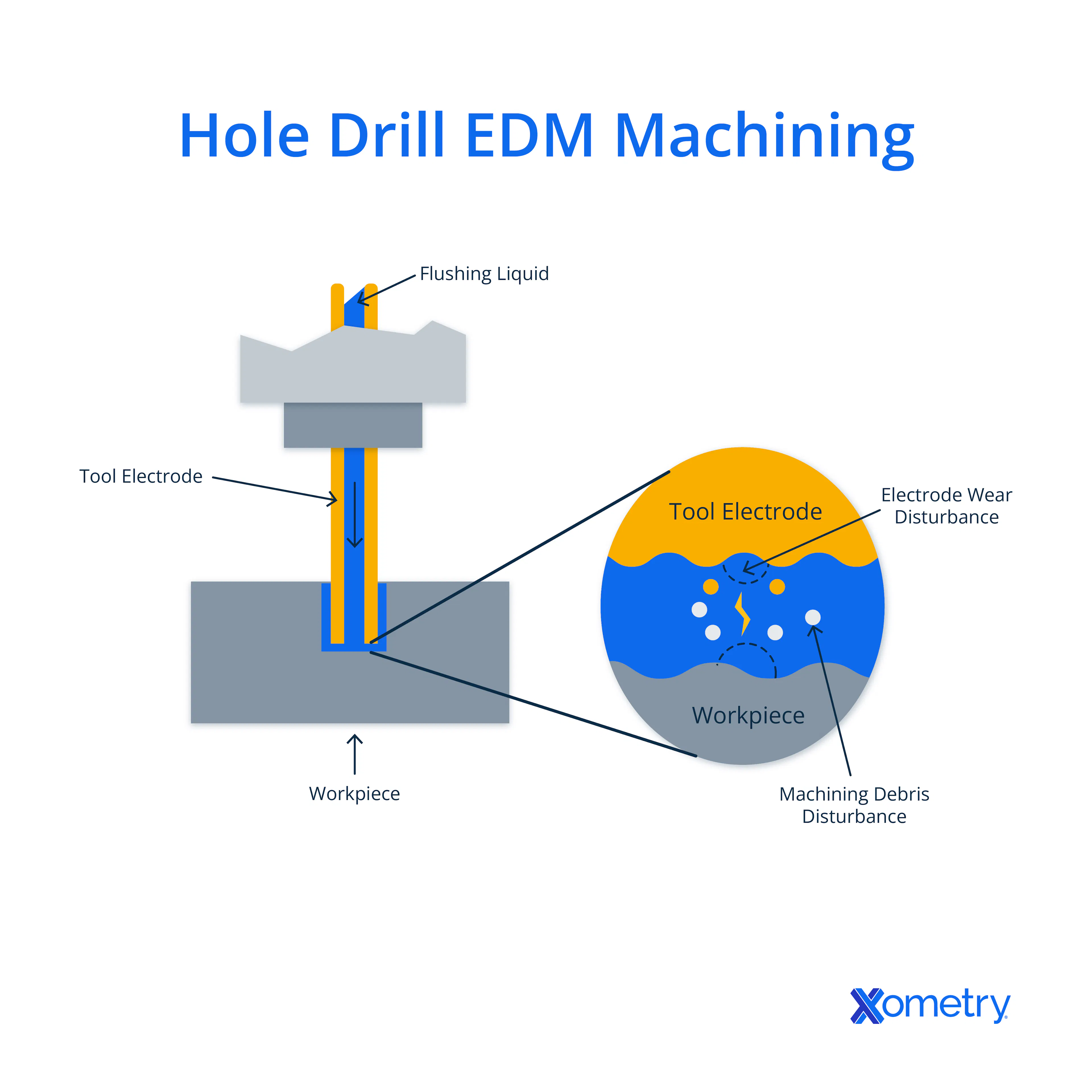
- Hole Drilling EDM: EDM hole drilling uses a hollow tubular electrode through which dielectric fluid flows, though rotation is optional depending on machine design. High-pressure dielectric fluid pumps through the electrode to flush out debris during the drilling cycle. Specialized guides ensure accuracy in All About Hole Drill EDM Machining: Definition and Applications.
- Fast Hole EDM: The machine uses a specialized power supply and high-pressure flushing to drill holes at high speeds. The process is used to create start holes for wire EDM operations or cooling channels. The equipment handles deep holes in hardened alloys efficiently.
- Micro EDM: The machine produces microscopic features using electrodes thinner than a human hair. The system operates using low discharge energies to prevent damage to delicate workpieces. High-resolution sensors monitor the spark gap to maintain micron-level precision.
Wire EDM
Wire EDM (Electrical Discharge Machining) uses a continuously moving thin wire electrode (brass or coated copper) to cut intricate two- or three-dimensional shapes in conductive materials. The wire moves through the material, eroding it by spark discharge, without any mechanical contact. Wire EDM is commonly used in industries that require high-precision cutting of hard metals and intricate geometries. It's frequently applied in aerospace, automotive, medical device manufacturing, and mold-making for producing parts like turbine blades, dies, and precision components.
Sinker EDM
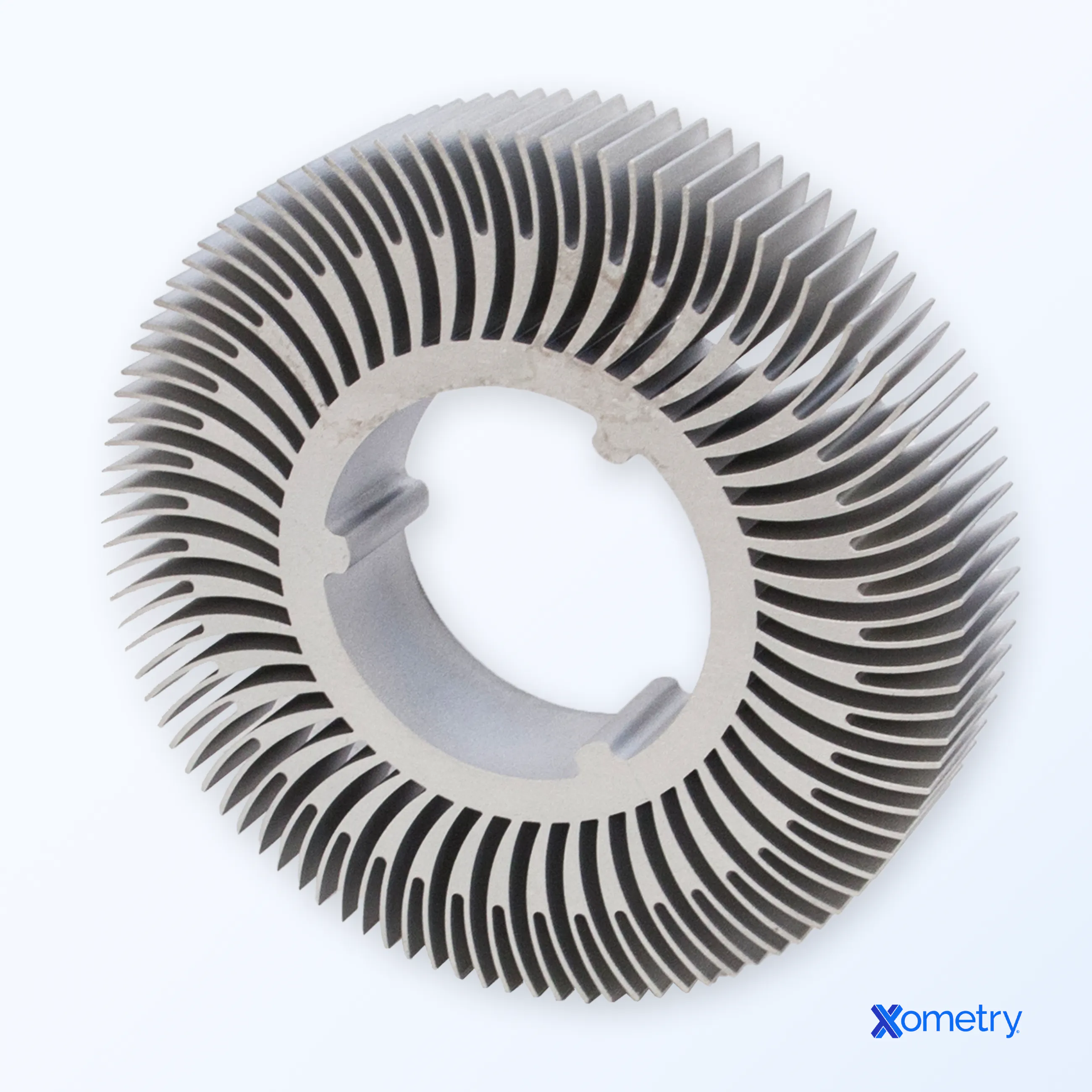
Sinker EDM uses a machined graphite or copper electrode to erode material from a workpiece, creating three-dimensional shapes. The electrode is shaped to match the desired feature and sinks into the material, creating molds, cavities, and intricate details. Sinker EDM is used in the manufacturing of complex molds and dies, especially in industries like automotive, aerospace, and injection molding. It is ideal for creating detailed cavities and complex geometries in hard materials.
Hole Drilling EDM
Hole Drilling EDM employs a rotating hollow tube electrode to create small-diameter, deep holes in conductive materials. High-pressure dielectric fluid flows through the electrode to flush out eroded material and prevent short circuits during the drilling process.
Hole Drilling EDM is commonly used in aerospace, automotive, and electronics industries for creating cooling channels, jet engine components, and intricate hole patterns in hard metals, where conventional drilling methods are not effective.
Fast Hole EDM
Fast Hole EDM uses specialized high-pressure dielectric fluid and power supplies to drill deep, small-diameter holes at high speeds. This method is optimized for efficient hole creation in hardened materials.
Fast Hole EDM is primarily used in aerospace for creating start holes for wire EDM operations or forming cooling channels in turbine blades and other high-performance components. It is also used in mold-making for precise hole creation.
Micro EDM
Micro EDM uses extremely fine electrodes to produce highly detailed, microscopic features with precision. The system operates at low discharge energies to ensure minimal thermal damage to delicate workpieces, allowing for micron-level accuracy.
Micro EDM is commonly used in industries requiring high-precision, miniature parts, such as medical device manufacturing, electronics, and micro-mechanics. It is used for applications (micro-molding, medical implants) , and producing fine details in small components.
What Does an EDM Machine Diagram Show?
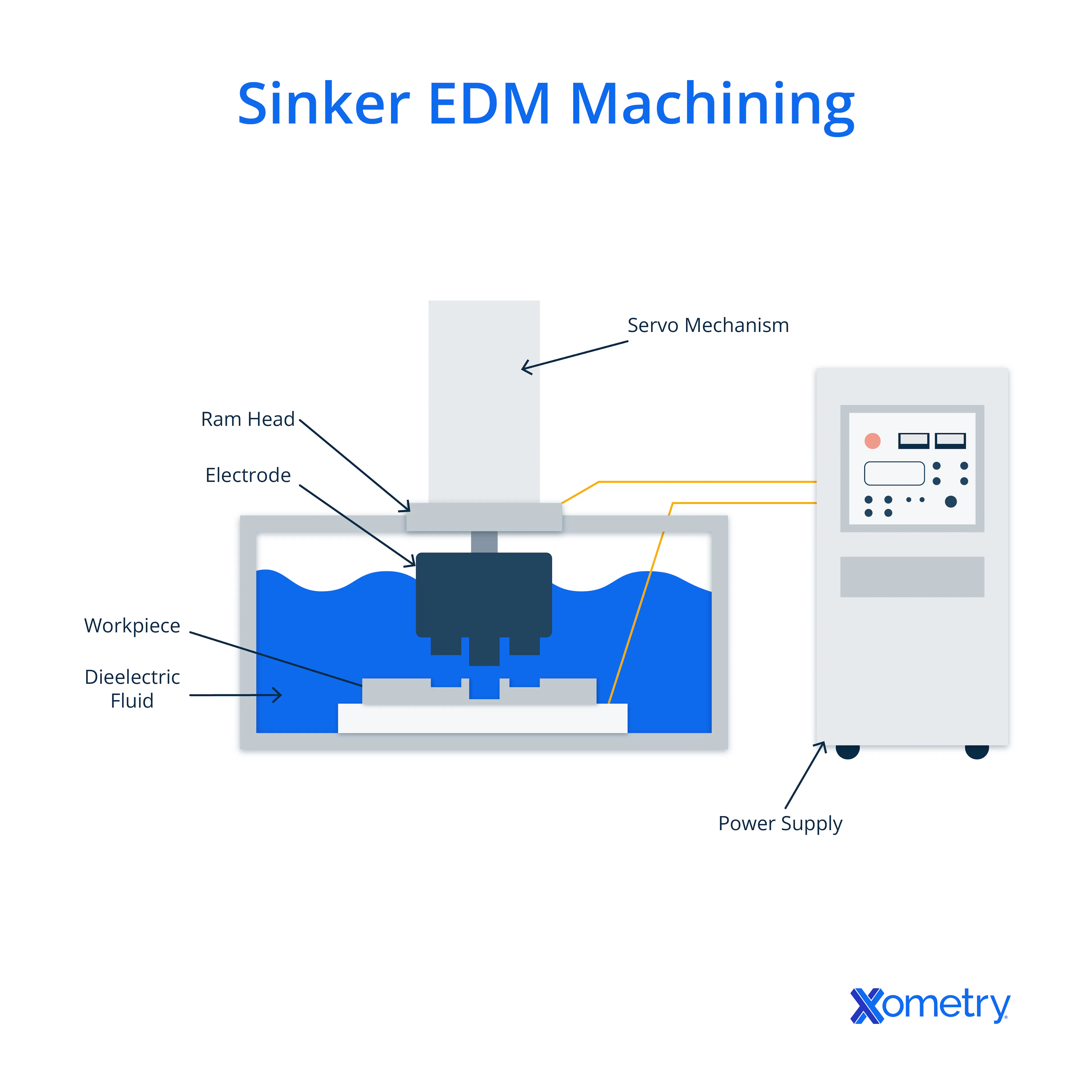
An EDM machine diagram shows the arrangement of the electrode, the workpiece, the power supply, and the dielectric system. The illustration clarifies how the power supply connects to the tool and the part to complete the electrical circuit. The diagram highlights the spark gap where material removal occurs. EDM diagrams commonly show dielectric circulation systems (pumps, filters, and flushing lines that direct fluid toward the machining zone). The servo motor system is depicted as the mechanism controlling the movement of the electrode. Spark generation is shown as a localized event between the two conductive surfaces. Labels identify the work tank that holds the fluid and the submerged components. Diagrams explain machine operation by visualizing the interaction of electrical and mechanical parts. Engineers use the interaction of electrical and mechanical parts to troubleshoot electrical connections or fluid delivery issues. EDM power supplies incorporate pulse generators and control circuits that regulate discharge energy, pulse duration, and frequency. Understanding the diagram helps operators visualize the non-contact nature of the erosion process.
What Components Are Included in an EDM Diagram?
An EDM (Electrical Discharge Machining) diagram includes several key components that are essential to the machining process. The electrode, made of conductive materials (copper or graphite), is the tool that creates electrical discharges across the gap. The workpiece is the material being machined, and it must be electrically conductive to interact with the discharges. Dielectric fluid normally acts as an electrical insulator until electrical breakdown occurs during a spark discharge, at which point it temporarily ionizes to form the plasma channel. The spark gap is the small space between the electrode and the workpiece where the electrical discharges occur, and maintaining a consistent gap is critical for stable erosion. EDM power supplies deliver controlled electrical pulses with adjustable parameters such as pulse duration, peak current, and pulse frequency. A servo control system regulates the movement of the electrode to maintain the proper gap between the electrode and the workpiece throughout the machining cycle, ensuring precision in the final part. The diagram provides a visual representation of how electrode and workpiece components work together to achieve high-precision material removal through spark erosion.
Does an EDM Diagram Include the Electrode and Workpiece?
Yes, both the electrode and workpiece are key components in an EDM diagram.
The electrode and workpiece are central to the EDM process and are always represented in the diagram. The electrode, which creates the electrical discharges, is shown positioned close to the workpiece, with a spark gap between them. The spark gap, a critical feature, is clearly highlighted in the diagram, as it is the area where the discharge energy occurs, leading to material removal. The positioning of the electrode and workpiece is crucial to the accuracy and precision of the machining process. Short-circuiting occurs, while an excessively large gap prevents stable spark generation, reducing machining efficiency if the spark gap becomes too small. The diagram ensures that electrode and workpiece components are placed in a manner that represents the controlled environment in which the spark discharges occur, maintaining consistent gap distances for optimal machining results.
What Materials Can Be Machined Using Electrical Discharge Machining (EDM)?
Materials that can be machined using electrical discharge machining (EDM) are listed below.
- Tool Steels: Tool steels are commonly used in manufacturing tools and dies. Their high hardness makes them ideal for EDM, where intricate shapes and high-precision cuts are needed in hardened materials.
- Stainless Steels: Stainless steels, known for their corrosion resistance, are machined using EDM, particularly in the production of complex components that require high precision, such as medical devices and aerospace parts.
- Carbides: Carbides, including tungsten carbide, are hard and difficult to machine with traditional methods. EDM is ideal for machining carbide components, which are used in cutting tools, mining equipment, and wear-resistant parts.
- Titanium Alloys: Titanium alloys, known for their strength and resistance to high temperatures, are frequently machined using EDM for applications in aerospace, medical, and automotive industries, where precision is crucial.
- Superalloys: Superalloys (Inconel and Hastelloy) are used in extreme conditions. EDM provides a way to machine superalloys, tough materials commonly found in turbine blades and other high-performance components.
- Aluminum (Conductive Grades): All standard aluminum alloys are electrically conductive and can be machined using EDM, though EDM is less commonly used for aluminum due to faster machining alternatives (milling). This is beneficial for producing intricate shapes in lightweight and non-ferrous components
- Copper and Brass: Copper and brass, both conductive materials, are easily machined using EDM. Copper and brass materials are common in electrical components, connectors, and heat exchangers, where high precision and complex designs are required.
1. Tool Steels
Tool steels represent a category of carbon and alloy steels known for their hardness and resistance to abrasion. These steels are used in tools that require durability and wear resistance. EDM machines treat these materials after heat treatment, avoiding thermal cracking or softening. The process ensures that hardened dies and other precision parts maintain their integrity. Tool steels are crucial in industries where high wear resistance and dimensional precision are essential, such as automotive, aerospace, and manufacturing. The EDM process allows for the efficient machining of complex parts, including with intricate shapes or thin walls. With EDM, manufacturers achieve the required tight tolerances without compromising the material’s strength or performance. The ability of EDM to create precise features in tool steels enables the production of high-quality, long-lasting tools and components. Tool Steels provide the necessary strength and durability in demanding applications, ensuring parts withstand high-stress conditions.
2. Stainless Steels
Stainless steels are iron alloys that contain at least 10.5% chromium, giving them their well-known corrosion resistance. EDM can machine stainless steels without mechanical cutting forces, which avoids issues associated with work hardening during conventional machining. The EDM process allows for precise machining without altering the material’s integrity. Stainless steel is commonly used in industries such as medical device manufacturing, automotive, and food processing due to its resistance to corrosion and high-temperature strength. The ability of EDM to cut through stainless steel without inducing stress or heat distortion makes it ideal for producing components with tight tolerances. This process ensures that parts retain their strength and durability, essential for high-performance applications. EDM also provides the flexibility to machine complex shapes and fine details in stainless steel, which would otherwise be challenging using traditional machining methods. Stainless Steel components are critical in producing items that must endure harsh environments, including valves, pumps, and medical implants.
3. Carbides
Carbides are materials composed of carbon combined with metals, such as tungsten or silicon. Due to their hardness, traditional tools fail to cut these substances effectively, resulting in rapid wear. EDM removes material through electrical discharge erosion (thermal melting and vaporization) rather than mechanical force. Carbides are commonly used in cutting tools, mining tools, and wear-resistant parts due to their extreme hardness. The EDM process allows for precise and intricate cuts, enabling the creation of complex shapes that would be difficult or impossible with mechanical tools. Carbide components are critical in industries such as aerospace, automotive, and manufacturing, where high durability and resistance to wear are essential. With EDM, carbide parts maintain their integrity and precise dimensions, which is crucial for high-performance applications. EDM produces very high localized temperatures at the spark site, though the heat is highly localized and generally causes less bulk distortion than mechanical cutting.
4. Titanium Alloys
Titanium alloys are renowned for their high strength-to-weight ratios and biocompatibility, making them suitable for medical applications. The EDM process prevents heat-related issues such as warping and oxidation, which are common when milling these reactive metals. Specifications and details on titanium alloys are found in Titanium: Definition, Characteristics, Grades, and Applications. The alloys' ability to maintain strength at high temperatures makes them indispensable in industries such as aerospace and automotive. EDM is essential for machining titanium alloys, allowing for intricate and precise shapes while preserving the material's properties. The process is capable of achieving tight tolerances, critical for the manufacturing of aerospace components and medical implants. Titanium Alloys ensure that parts are durable and lightweight, which is crucial for applications where weight reduction is important without sacrificing strength.
5. Superalloys
Superalloys, such as Inconel and Hastelloy, are high-performance metals designed to withstand extreme temperatures and mechanical stress. EDM can machine superalloys without mechanical cutting forces, but it produces a recast layer and heat-affected zone on the surface, which may require finishing passes or post-processing. Superalloys are commonly used in high-temperature applications such as jet engines and gas turbines. The EDM process ensures that the complex shapes and fine details required for superalloy components are achieved without compromising the material's strength. Superalloys maintain their performance even in extreme conditions, making them essential in industries where high durability is crucial. The precision offered by EDM helps produce superalloy parts with tight tolerances, reducing the need for post-machining adjustments. Superalloy metals are vital in the aerospace and power generation industries, where failure to meet stringent performance standards has significant consequences.
6. Aluminum (Conductive Grades)
Aluminum is a lightweight, conductive metal widely used in industries like aerospace and automotive. EDM is effective on conductive grades of aluminum, enabling the creation of complex features such as internal cooling channels. EDM introduces localized thermal effects and can produce a recast layer, although it typically causes less mechanical distortion than conventional cutting due to the absence of cutting forces. The material's low density and excellent conductivity make it ideal for intricate, high-performance applications. Aluminum alloys generally do not exhibit significant work hardening during machining compared with materials such as stainless steel or nickel superalloys. The use of conductive grades of aluminum in EDM ensures that components maintain strength while being lightweight. Aluminum Metal offers enhanced performance in parts that require tight tolerances and high durability in demanding environments.
7. Copper and Brass
Copper and brass are metals known for their high electrical conductivity, making them ideal for use as both workpieces and electrodes in EDM. The process enables the creation of complex connectors and electrodes used in various EDM operations. These materials are useful in applications that require intricate electrical components due to their excellent conductive properties. Copper and brass are machined using EDM, though high electrical and thermal conductivity can reduce machining efficiency compared with materials such as tool steels. The high conductivity of these metals also ensures optimal energy transfer during the machining process. The use of copper and brass in EDM allows for faster and more accurate production of electrical components. Copper Metal is extensively utilized in manufacturing industries where high precision and electrical performance are required.
What Are the Advantages of Electrical Discharge Machining (EDM)?
The advantages of electric discharge machining (EDM) are listed below.
- Precision: EDM provides exceptional precision, allowing for the creation of intricate and complex shapes with tight tolerances. It is ideal for machining hard and difficult-to-cut materials, producing parts with fine details that would be challenging with traditional methods.
- No Mechanical Stress: Unlike conventional cutting methods, EDM does not apply mechanical pressure to the material. EDM removes material without mechanical cutting forces, significantly reducing mechanical deformation, though thermal effects can still influence the surface layer.
- Ability to Machine Hard Materials: EDM is effective on hard materials such as tool steels, carbides, and superalloys, which are difficult or impossible to machine using conventional methods. The process easily cut through hardened metals without causing cracks or thermal damage.
- Complex Geometries: EDM excels in producing complex geometries, including internal features (deep holes, slots, and cavities). The process is highly versatile and creates shapes that are difficult to achieve using other machining methods.
- Minimal Heat-Affected Zone: EDM produces a localized heat-affected zone and recast layer, which are thin but may require finishing operations for high-performance applications. Minimal Heat-Affected Zone is beneficial when working with heat-sensitive materials or requiring high levels of precision.
Why Is Electrical Discharge Machining (EDM) Preferred for High-Precision Manufacturing?
Electrical discharge machining is preferred for high-precision manufacturing because it achieves extremely tight tolerances. Spark control allows micro-level detail to be reproduced consistently across multiple parts. The process is ideal for creating molds and dies where micron-level accuracy is mandatory. The absence of mechanical cutting forces reduces mechanical deflection and deformation, helping maintain dimensional accuracy. EDM's ability to cut complex geometries without the risk of tool wear or deformation is another key factor in its precision. EDM produces a localized heat-affected zone and recast layer, though these are typically thin and manageable with finishing passes. further improving dimensional stability. EDM produces a localized heat-affected zone and recast layer, though these are typically thin and manageable with finishing passes. These advantages make EDM invaluable in industries like aerospace, medical device manufacturing, and automotive, where high precision is critical.
Does Electrical Discharge Machining (EDM) Produce Burr-Free Surfaces?
Yes, EDM produces burr-free surfaces. No mechanical cutting edges are involved in the process. Material removal occurs through vaporization instead of physical shearing, which prevents the creation of burrs. As a result, the edges of the workpiece remain smooth and clean. The absence of tool contact reduces the likelihood of material deformation or surface imperfections, which lead to burr formation. EDM produces recast layers and micro-craters, and some applications require secondary finishing processes such as polishing or secondary EDM passes. The burr-free quality of EDM makes it suitable for high-precision applications where part integrity and surface quality are critical.
What Are the Limitations of Electrical Discharge Machining (EDM)?
The Limitations of Electrical Discharge Machining (EDM) are listed below.
- Limited Material Range: EDM is primarily effective on conductive materials, meaning non-conductive materials (plastics or ceramics) cannot be machined. EDM is limited to electrically conductive materials, which include metals and some conductive ceramics or composites, not exclusively metals.
- Slow Material Removal Rate: The EDM process has a slower material removal rate compared to conventional machining methods like milling or turning. Slow material removal rate results in longer production times for large parts or when high volumes of material need to be removed.
- High Initial Setup Costs: EDM machines require significant upfront investment in both equipment and maintenance. The complexity of the machines and the precision they offer contribute to the high initial cost, which may not be ideal for small-scale operations.
- Electrode Wear: In EDM, the electrode material wears down during the machining process, requiring frequent replacement or re-sharpening. Electrode wear results in additional operational costs and may require more time to maintain the equipment.
- Heat-Affected Zone: EDM produces a localized heat-affected zone and recast layer, the thickness of which depends on discharge energy and machining parameters. The heat-affected zones lead to microstructural changes or slight thermal damage in sensitive materials.
- Surface Finish Limitations: Although EDM produces smooth surfaces, the finish is not as fine as those produced by grinding or polishing. Some applications may require additional post-machining processes to achieve the desired surface quality.
How Does Electrical Discharge Machining (EDM) compare to CNC Machining?
Electrical discharge machining differs from CNC machining primarily in the method of material removal and the speed of the operation. EDM uses a series of electrical sparks to erode material, while CNC machining employs physical cutting tools to chip away metal. EDM produces a localized heat-affected zone and recast layer, the thickness of which depends on discharge energy and machining parameters. CNC tools wear down quickly on hard alloys, increasing the cost of consumables and downtime. The EDM process achieves finer internal radii and deeper cavities that traditional rotating tools cannot reach. CNC Machining requires rigid fixturing to endure cutting forces, whereas EDM exerts no mechanical pressure on the part. Small, delicate components remain safer in an EDM environment compared to high-force CNC milling.
How Does Electrical Discharge Machining (EDM) Compare to Plasma Cutting?
Electrical discharge machining compares to plasma cutting as a high-precision alternative for conductive materials. EDM uses controlled electrical discharges inside a dielectric fluid to achieve high accuracy. Plasma cutting utilizes a high-temperature stream of ionized gas to melt through thick metal plates at high speeds. EDM provides a higher level of precision and a superior surface finish. Plasma cutting leaves a heat-affected zone and dross that requires secondary grinding. EDM generally produces burr-free edges, but it also forms a recast layer and localized heat-affected zone on the machined surface. Complex three-dimensional geometries and tiny holes are impossible for plasma cutters to execute. Industrial shops choose plasma for heavy-duty fabrication and EDM for precision tooling. Thick plates are processed via Plasma Cutting.
Is Electrical Discharge Machining (EDM) Slower Than Traditional Machining Methods?
Yes, EDM is slower than traditional machining methods. The process focuses on precision instead of speed. EDM removes material through rapid sequences of electrical discharges (thousands to hundreds of thousands of pulses per second). Engineers choose the technique for detailed components where precision requirements justify the extended cycle times. Conventional milling removes material in large chips, providing greater efficiency for basic shaping. EDM is ideal for creating complex geometries and intricate features, but comes at the cost of longer production times. Although EDM is slower, it offers unmatched accuracy and precision in materials that are difficult to machine using traditional methods. The slow speed is compensated for by the ability to produce highly detailed parts that traditional machining methods cannot achieve. While not suited for mass production, EDM excels in specialized applications requiring extreme precision. This makes EDM a valuable tool in industries such as aerospace, automotive, and medical device manufacturing.
Electrical Discharge Machining (EDM) is best understood as a precision-first process rather than a speed-first one. Its real value in manufacturing comes from the ability to machine hardened conductive materials and produce internal features, sharp details, and fine cavities that conventional cutting methods struggle to achieve. The absence of mechanical cutting force makes EDM especially useful for delicate geometries where distortion, chatter, or tool pressure would compromise dimensional accuracy. At the same time, the process carries tradeoffs in slower removal rates, electrode wear, and possible recast-layer concerns that must be managed through proper parameter selection. In high-tolerance industries such as aerospace, medical, and toolmaking, EDM remains one of the most important processes for producing parts that require accuracy beyond the practical reach of standard machining.
What is Electrical Discharge Machining (EDM) Used for in Manufacturing?
Electrical discharge machining is used to create molds, dies, and high-precision parts in modern manufacturing. The technology excels at producing complex cavities in hardened tool steels used in injection molding. Aerospace engineers utilize the process to drill small cooling holes in turbine blades made from superalloys. The medical industry relies on the method to manufacture surgical instruments and orthopedic implants with intricate details. Tool and die shops depend on wire EDM to cut extrusion dies and stamping tools with tight tolerances. Internal splines and keyways can be produced using broaching, shaping, or CNC machining, though EDM may be used for hardened materials or complex internal geometries. Prototype development benefits from the ability to machine hard metals without creating custom cutting tools. Micro-EDM creates tiny nozzles for fuel injectors and inkjet printers. EDM is used to manufacture electrodes for EDM processes and precision tooling, rather than broadly producing electrodes for unrelated industrial processes. Consistency in surface finish makes it suitable for aesthetic parts in consumer electronics. The method remains indispensable to industries requiring high accuracy on difficult-to-machine materials.
What Industries Use Electrical Discharge Machining (EDM) Machines the Most?
Industries That Use Electrical Discharge Machining (EDM) Machines are listed below.
- Aerospace: EDM is widely used in the aerospace industry for producing high-precision components such as turbine blades, jet engine parts, and fuel nozzles. The ability to machine hard materials and intricate shapes makes EDM ideal for this demanding sector.
- Automotive: In the automotive industry, EDM is employed for manufacturing mold tools, dies, and precision parts. In the automotive industry, EDM is used for manufacturing tooling (molds, dies, and stamping tools) rather than for large-scale production of engine components.
- Medical Device Manufacturing: EDM is commonly used in medical device manufacturing for creating intricate parts (surgical instruments, implants, and molds). The process ensures that parts meet stringent tolerance and biocompatibility requirements.
- Tool and Die Making: Tool and die makers rely on EDM to produce complex molds, dies, and stamping tools. The process allows for high precision and the ability to machine hard materials without affecting the structural integrity of the parts.
- Electronics: EDM is used to manufacture precision tooling (molds and dies) used to produce electronic components, rather than directly producing most connectors or housings. Its ability to machine fine details in small parts is crucial for modern electronic applications.
- Defense: In defense manufacturing, EDM is used for creating high-precision components for weapons systems, radar systems, and military vehicles. The ability to work with high-strength alloys and exact tolerances is critical in this sector.
Is Electrical Discharge Machining (EDM) Common in Medical Manufacturing?
Yes, EDM is common in medical manufacturing. The process handles high-strength alloys like titanium and stainless steel, which are essential for medical devices and implants. Precision remains critical to patient safety during the use of surgical instruments, as even minor inaccuracies lead to complications. EDM is useful in creating tiny features on implantable devices such as pacemakers, joint replacements, and dental implants, where precision is paramount. The technology also ensures that medical-grade parts have the burr-free finish required for safe and smooth functionality. With its ability to produce intricate geometries, EDM allows the production of complex components that traditional machining methods cannot achieve. EDM introduces localized thermal effects (recast layer and heat-affected zone), though EDM produces minimal mechanical stress compared with conventional cutting methods.
How Accurate is Electrical Discharge Machining (EDM)?
Electrical Discharge Machining achieves high precision tolerances typically around ±0.005 mm to ±0.02 mm depending on machine capability, geometry, and process parameters. The level of accuracy depends on the stability of the machine environment and the quality of the electrode material. Advanced control systems adjust the spark gap in real-time to maintain the intended dimensions. The absence of mechanical force eliminates the risk of tool deflection or workpiece bending during the process. Some advanced EDM machines use thermal compensation systems or temperature monitoring, though dimensional stability is primarily maintained through machine design, environmental control, and process parameters. High-resolution linear scales track the position of the machine axes to ensure repeatable results. Precision is improved by using fine-grain graphite or copper electrodes with minimal wear characteristics. The technology achieves sharp internal corners and smooth surface finishes unreachable by traditional milling. Manufacturers rely on the consistency of the process to produce interchangeable parts for critical systems. EDM can maintain good dimensional accuracy in thick or hardened materials, though machining stability depends on flushing efficiency, electrode wear, and spark gap control.
What Tolerance can an Electrical Discharge Machining (EDM) Machine Achieve?
Electrical discharge machining machines achieve tolerances around ±0.005 mm to ±0.02 mm depending on machine capability, part geometry, and process parameters. Ultra-precision EDM systems can achieve tolerances approaching ±0.002–±0.005 mm under highly controlled conditions. The values represent the deviation from the programmed dimensions under controlled laboratory conditions. Accuracy depends on the careful calibration of the electrode and the stability of the dielectric fluid. The machine's ability to maintain consistent spark gaps during the process ensures that precise dimensions are achieved. The use of advanced sensors and real-time adjustments further enhances the machine's ability to maintain tight tolerances over prolonged operations. EDM machines are capable of working on complex geometries and thin-walled structures while still meeting these high tolerance requirements. These capabilities make EDM ideal for industries where precision is paramount, such as aerospace, medical device manufacturing, and toolmaking.
Can Electrical Discharge Machining (EDM) Achieve Micron-Level Accuracy?
Yes, EDM can achieve micron-level tolerances. Spark control ensures fine detail, enabling the creation of highly intricate features with extreme precision. This capability allows EDM to produce ultra-precision components that meet the strictest requirements, especially in industries such as aerospace, medical device manufacturing, and electronics. Ultra-precision EDM systems can achieve tolerances on the order of a few microns (≈ ±2–±5 µm) under controlled conditions and with appropriate machine capability. EDM’s ability to work with hard-to-machine materials and produce sharp, complex shapes further enhances its suitability for ultra-precision applications. The accuracy remains consistent throughout the process, even for high-precision parts that require long machining times.
How Xometry Can Help
Xometry provides a wide range of manufacturing capabilities including CNC machining, 3D printing, injection molding, laser cutting, and sheet metal fabrication. Get your instant quote today.
Copyright and Trademark Notices
- Inconel® is a registered trademark of Special Metals Corporation
Disclaimer
The content appearing on this webpage is for informational purposes only. Xometry makes no representation or warranty of any kind, be it expressed or implied, as to the accuracy, completeness, or validity of the information. Any performance parameters, geometric tolerances, specific design features, quality and types of materials, or processes should not be inferred to represent what will be delivered by third-party suppliers or manufacturers through Xometry’s network. Buyers seeking quotes for parts are responsible for defining the specific requirements for those parts. Please refer to our terms and conditions for more information.